
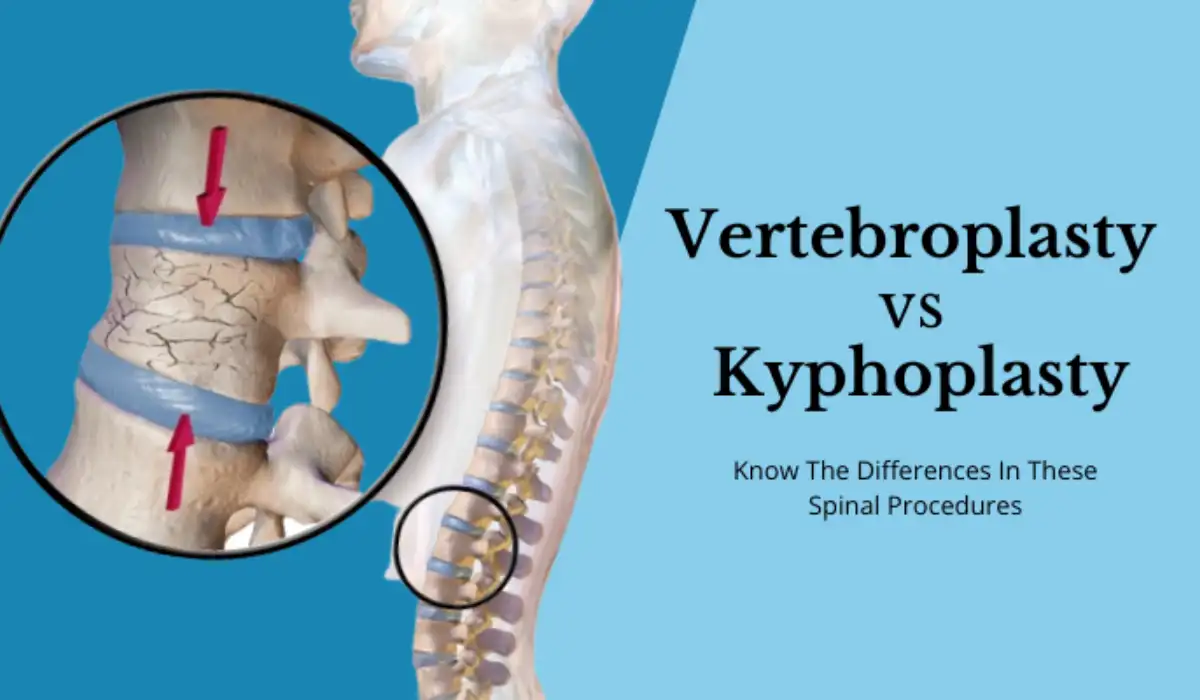
Kyphoplasty vs vertebroplasty is a common question for people with painful vertebral compression fractures. Both are minimally invasive spine procedures that use bone cement to stabilize a fractured vertebra. However, kyphoplasty uses a small balloon first, while vertebroplasty injects cement directly into the broken bone.
In simple terms, vertebroplasty is mainly used to stabilize the fracture. Kyphoplasty also stabilizes the fracture, but it may help restore some lost vertebral height in selected cases. Therefore, the better option depends on the fracture pattern, pain severity, imaging results, bone health, and doctor recommendation.
Kyphoplasty vs Vertebroplasty
The main difference between kyphoplasty and vertebroplasty is the balloon step. Kyphoplasty uses a balloon-like device to create space inside the fractured vertebra before cement is injected.
Vertebroplasty does not use a balloon. Instead, bone cement is injected directly into the fractured vertebra to stabilize the bone and reduce painful movement at the fracture site.
Kyphoplasty vs Vertebroplasty Comparison Table
| Feature | Kyphoplasty | Vertebroplasty |
| Main purpose | Stabilizes fracture and may restore some height | Stabilizes fracture |
| Balloon used | Yes | No |
| Cement used | Yes | Yes |
| Height restoration | Possible in selected cases | Usually not expected |
| Procedure type | Minimally invasive | Minimally invasive |
| Imaging guidance | Fluoroscopy or X-ray guidance | Fluoroscopy or X-ray guidance |
| Common condition treated | Vertebral compression fracture | Vertebral compression fracture |
| Cement injection | Into balloon-created space | Directly into fractured bone |
| Recovery | Often same day, but varies | Often same day, but varies |
| Main risk | Cement leakage, bleeding, infection, nerve irritation | Cement leakage, bleeding, infection, nerve irritation |
| Best for | Selected recent fractures with height loss or deformity | Selected painful fractures needing stabilization |
What Do Kyphoplasty and Vertebroplasty Treat?
Kyphoplasty and vertebroplasty treat painful vertebral compression fractures. These fractures happen when a vertebra in the spine weakens, cracks, or collapses.
Most vertebral compression fractures are linked with osteoporosis. However, they may also occur after trauma, long-term steroid use, cancer, multiple myeloma, or other conditions that weaken bone.
As a result, treatment should not focus only on pain relief. Bone health, fall prevention, osteoporosis care, and future fracture risk should also be addressed.
What Is Kyphoplasty?
Kyphoplasty is a minimally invasive spine procedure used to treat a painful vertebral compression fracture. During the procedure, a doctor places a hollow needle into the fractured vertebra using imaging guidance.
Next, a small balloon-like device is inserted through the needle and inflated. This creates a space inside the fractured bone and may help improve some loss of vertebral height.
After that, the balloon is removed, and medical-grade bone cement is injected into the created space. Once the cement hardens, it helps stabilize the fractured vertebra.
What Is Vertebroplasty?
Vertebroplasty is also a minimally invasive procedure for painful vertebral compression fractures. However, it does not include the balloon step.
During vertebroplasty, the doctor guides a needle into the fractured vertebra using X-ray or fluoroscopy guidance. Then, bone cement is injected directly into the broken bone.
The cement hardens quickly and helps stabilize the fracture. Therefore, vertebroplasty is mainly used to reduce pain caused by movement at the fracture site.
Main Difference Between Kyphoplasty and Vertebroplasty
The main difference is that kyphoplasty uses a balloon before cement placement, while vertebroplasty does not.
Because kyphoplasty creates a cavity first, cement may be injected into a more controlled space. In contrast, vertebroplasty places cement directly into the fractured bone.
However, both procedures share the same overall goal. They aim to stabilize a painful compression fracture and help patients move more comfortably.
Which Is Better: Kyphoplasty or Vertebroplasty?
Kyphoplasty may be better for some patients when the fractured vertebra has lost height and the doctor believes balloon expansion may help restore part of the shape.
Vertebroplasty may be considered when the main goal is stabilization rather than height restoration. It may also be used when the fracture pattern is suitable for direct cement injection.
Overall, there is no single best choice for everyone. The right procedure depends on imaging results, fracture age, pain severity, spinal stability, medical history, and the specialist’s judgment.
Why Some Doctors Prefer Kyphoplasty?
Some doctors may prefer kyphoplasty because the balloon creates a space before cement placement. As a result, it may allow lower-pressure cement injection in selected cases.
Kyphoplasty may also help restore some vertebral height when the fracture is recent and the bone has not fully healed in a collapsed position.
However, height restoration is not guaranteed. The amount of correction depends on the fracture type, timing, bone quality, and how much collapse has already occurred.
Why Some Doctors Choose Vertebroplasty?
Some doctors may choose vertebroplasty when the fracture needs stabilization but balloon expansion is not necessary.
Vertebroplasty may be technically simpler because the cement is injected directly into the fractured vertebra. It may also be chosen based on patient anatomy, fracture appearance, availability, and provider experience.
Still, vertebroplasty is not suitable for every compression fracture. Proper imaging is needed to confirm that the pain comes from an active fracture.
When These Procedures May Be Recommended?
Doctors may consider kyphoplasty or vertebroplasty when severe back pain clearly matches a recent vertebral compression fracture and conservative care has not provided enough relief.
For example, a person may have pain that limits standing, walking, sleeping, breathing deeply, or basic daily activities. In these cases, stabilizing the fracture may help improve mobility.
However, many compression fractures improve with nonsurgical care. Therefore, a doctor may first recommend rest, pain medicine, bracing, careful activity, and osteoporosis treatment.
When These Procedures May Not Be Right?
Kyphoplasty and vertebroplasty are not standard treatments for ordinary back pain, muscle strain, arthritis, spinal stenosis, or herniated discs.
They may also be unsafe in certain burst fractures, spinal instability, active infection, severe bleeding problems, significant nerve compression, or fractures that have already healed.
In addition, these procedures may not be useful when pain does not match the fracture location. That is why imaging and a physical exam are important before treatment.
Imaging Before Kyphoplasty or Vertebroplasty
Imaging helps doctors confirm whether a compression fracture is new, active, stable, healed, or related to another condition.
X-rays may show vertebral collapse or height loss. However, MRI can often help show whether the fracture is recent because active fractures may show bone swelling.
CT may be used when doctors need more detail about bone structure, fracture shape, or the spinal canal. In some cases, a bone scan may be used when MRI is not possible.
What Happens During Kyphoplasty?
During kyphoplasty, the patient usually lies face down. The skin is cleaned, numbed, and prepared in a sterile way.
Then, the doctor guides a needle into the fractured vertebra using imaging. A balloon-like device is inserted and inflated to create space inside the bone.
After the balloon is removed, bone cement is injected into the space. Finally, the needle is removed, the small skin opening is covered, and the patient is monitored during recovery.
What Happens During Vertebroplasty?
Vertebroplasty starts in a similar way. The patient lies face down, and the treatment area is cleaned and numbed.
Next, the doctor places a needle into the fractured vertebra using imaging guidance. Bone cement is then injected directly into the bone without using a balloon.
After the cement hardens, the needle is removed and the area is bandaged. In many cases, the patient is monitored for a short time before going home.
Recovery After Kyphoplasty vs Vertebroplasty
Recovery after kyphoplasty or vertebroplasty is usually faster than recovery after open spine surgery. Many patients go home the same day, although some need longer observation.
Pain relief may happen quickly for some people. However, others may notice improvement over several days. Mild soreness at the needle site can also happen.
After either procedure, doctors may advise avoiding heavy lifting, twisting, or strenuous activity for a period of time. In addition, follow-up care is important to monitor pain, mobility, and bone health.
Risks and Possible Complications
Both procedures are minimally invasive, but they still have risks. Possible complications include bleeding, infection, increased pain, nerve irritation, numbness, tingling, cement leakage, allergic reaction, or another fracture.
Cement leakage is one of the main concerns. Often, small leakage does not cause symptoms. However, leakage near nerves, the spinal canal, or blood vessels can be serious.
Therefore, these procedures should be performed by trained specialists using imaging guidance and careful patient selection.
Do These Procedures Treat Osteoporosis?
Kyphoplasty and vertebroplasty do not treat osteoporosis. They only stabilize a specific fractured vertebra.
Therefore, people with osteoporosis may still need a bone density test, fall-prevention plan, vitamin D and calcium guidance, weight-bearing activity when safe, and prescription osteoporosis treatment when appropriate.
This step matters because one spinal fracture can increase the risk of another fracture.
Kyphoplasty vs Vertebroplasty Cost
Cost can vary by country, hospital, insurance coverage, anesthesia type, imaging needs, number of spinal levels treated, and whether the procedure is outpatient or inpatient.
Kyphoplasty may cost more in some settings because it uses additional balloon equipment. However, exact pricing should be confirmed with the hospital, insurance provider, and treating specialist.
Do not choose based on cost alone. Instead, ask which procedure is medically appropriate for your fracture and what out-of-pocket charges may apply.
Questions to Ask Your Doctor
Ask whether your back pain clearly matches an active vertebral compression fracture. Also, ask whether the fracture is recent, stable, healing, or already healed.
You can also ask whether kyphoplasty or vertebroplasty is more suitable for your imaging results. In addition, ask about risks, anesthesia, recovery time, activity limits, and future fracture prevention.
Finally, ask what happens if you choose conservative care instead of a procedure.
When to Seek Urgent Medical Help?
Seek urgent medical care if back pain follows a major fall, accident, or injury. Also, get help quickly if pain is severe, worsening, or linked with fever.
Urgent symptoms include new leg weakness, numbness, trouble walking, loss of bladder or bowel control, or numbness in the groin area.
These symptoms may suggest nerve or spinal cord involvement and should not be ignored.
Conclusion
Kyphoplasty vs vertebroplasty mainly comes down to one difference: kyphoplasty uses a balloon before cement injection, while vertebroplasty injects cement directly into the fractured vertebra.
Both procedures may help selected patients with painful vertebral compression fractures. However, the best choice depends on the fracture pattern, imaging results, pain level, bone health, and medical advice.
FAQs
Kyphoplasty uses a balloon to create space before cement injection. Vertebroplasty injects cement directly into the fractured vertebra without using a balloon.
Neither is best for everyone. Kyphoplasty may help selected fractures with height loss, while vertebroplasty may be used when stabilization is the main goal.
Kyphoplasty may reduce cement leakage risk in some cases because cement is placed into a balloon-created space. However, both procedures still carry risks.
Vertebroplasty usually does not restore vertebral height. Its main goal is to stabilize the fractured bone and reduce pain from movement.
Kyphoplasty often takes less than an hour for one spinal level, but timing can vary based on the number of fractures and the patient’s condition.
Vertebroplasty is often completed in a short procedure time, but timing varies by fracture location, number of levels treated, anesthesia, and imaging needs.