
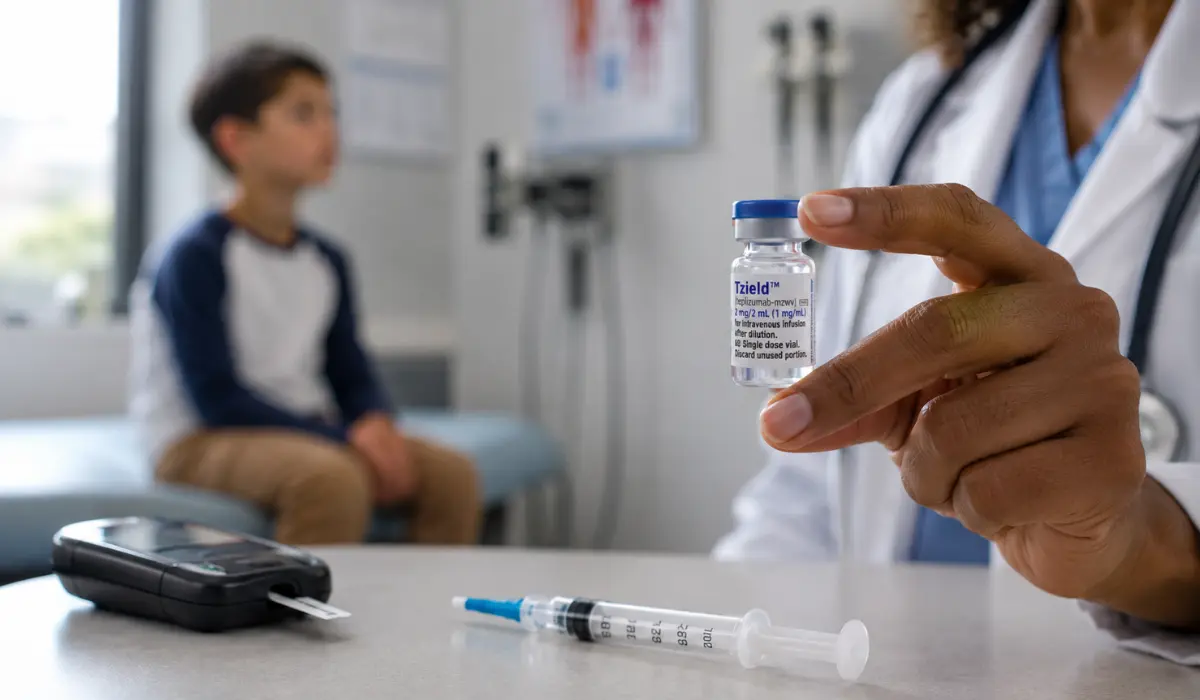
Sanofi has announced that the US Food and Drug Administration has granted accelerated approval for Tzield, also known as teplizumab-mzwv, for certain children recently diagnosed with stage 3 type 1 diabetes.
The approval applies to children aged 8 to 17 years who have recently been diagnosed with stage 3 type 1 diabetes. Tzield is intended to delay the decline in endogenous insulin production, meaning the body’s own ability to produce insulin.
This marks an important regulatory milestone because Tzield is described as the first disease-modifying therapy approved in the US for patients recently diagnosed with stage 3 type 1 diabetes.
What The New Approval Means?
Type 1 diabetes is an autoimmune condition in which the immune system attacks insulin-producing beta cells in the pancreas. By the time a person reaches stage 3 type 1 diabetes, blood sugar levels have reached the clinical diabetes range, and symptoms may begin to appear.
Common symptoms can include increased thirst, frequent urination, unexplained weight loss, blurred vision, and fatigue. Most patients at this stage require daily insulin therapy to manage blood sugar levels.
The new approval gives eligible children and healthcare providers another treatment option focused on preserving the body’s remaining insulin production for longer. Tzield does not replace insulin, but it targets the autoimmune process involved in type 1 diabetes progression.
Approval Based On PROTECT Phase 3 Study
The FDA’s accelerated approval was supported by the PROTECT phase 3 study, a randomized, double-blind, placebo-controlled multinational trial.
The study enrolled 328 children and adolescents aged 8 to 17 years who had been diagnosed with stage 3 type 1 diabetes within the previous six weeks. Participants received either Tzield or placebo in two treatment courses, with each course involving 12 daily infusions.
The study measured beta-cell function using C-peptide levels after a mixed-meal tolerance test. Sanofi reported that Tzield significantly slowed the decline in mean C-peptide levels compared with placebo at trial completion.
C-peptide is often used as a marker of the body’s natural insulin production. Slowing the decline of C-peptide may suggest that the body is preserving more beta-cell function for a longer period.
Safety Information
Sanofi stated that adverse events seen in the PROTECT study were consistent with previous studies of Tzield.
The most common adverse reactions included lymphopenia, vomiting, rash, leukopenia, diarrhea, neutropenia, increased liver transaminase, and headache.
Serious risks have also been reported with Tzield, including cytokine release syndrome and life-threatening cases of viral reactivation. Patients who are immunocompromised may face a higher risk of viral reactivation.
Because of these risks, treatment decisions should be made by qualified healthcare professionals after reviewing a patient’s medical history, immune status, and overall diabetes care needs.
Accelerated Approval And Confirmatory Study
The new indication was granted under the FDA’s accelerated approval pathway. This pathway allows earlier approval of medicines for serious conditions when they address an unmet medical need and are supported by a surrogate endpoint reasonably likely to predict clinical benefit.
In this case, the approval is based on evidence that Tzield reduced the decline in C-peptide levels. Continued approval may depend on confirmatory studies verifying and describing the expected clinical benefit.
Sanofi said the BETA-PRESERVE phase 3 confirmatory study has been initiated and is currently enrolling participants.
Earlier Tzield Approvals
Tzield was first approved in the US in November 2022 to delay the onset of stage 3 type 1 diabetes in adults and children aged 8 years and older with stage 2 type 1 diabetes.
In April 2026, the FDA expanded that indication to include children aged 1 year and older with stage 2 type 1 diabetes.
The therapy is also approved in several international markets to delay the onset of stage 3 type 1 diabetes in eligible patients with stage 2 disease. In the European Union, it is approved under the name Teizeild.
Why This Matters?
For children recently diagnosed with stage 3 type 1 diabetes, preserving remaining beta-cell function may be clinically meaningful. Even after diagnosis, some patients still produce a measurable amount of their own insulin.
A therapy that slows the decline of this remaining insulin production could support a more proactive approach to type 1 diabetes care, although insulin therapy and regular medical monitoring remain central to disease management.
Sanofi said the approval may help healthcare providers address the autoimmune and progressive nature of type 1 diabetes earlier in the stage 3 disease course.
Conclusion
The FDA’s accelerated approval of Tzield for children aged 8 to 17 recently diagnosed with stage 3 type 1 diabetes represents a notable development in type 1 diabetes treatment.
Rather than focusing only on blood sugar management, Tzield is designed to target the autoimmune process that contributes to beta-cell loss. However, the approval is based on a surrogate endpoint, and continued approval may depend on confirmatory evidence showing clinical benefit.
Families considering Tzield should speak with a diabetes specialist or qualified healthcare provider to understand eligibility, treatment timing, infusion requirements, possible benefits, and safety risks.
References
- Sanofi Press Release: Tzield Approved for Recently Diagnosed Stage 3 Type 1 Diabetes
https://www.sanofi.com/en/media-room/press-releases/2026/2026-06-12-22-09-58-3311349 - FDA: FDA Approves Drug for Pediatric Stage 3 Type I Diabetes
https://www.fda.gov/drugs/news-events-human-drugs/fda-approves-drug-pediatric-stage-3-type-i-diabetes - Reuters: FDA Approves Expanded Use of Sanofi’s Type 1 Diabetes Drug
https://www.reuters.com/legal/litigation/fda-approves-sanofis-drug-stage-3-type-1-diabetes-children-2026-06-12/ - NEJM: Teplizumab and Beta-Cell Function in Newly Diagnosed Type 1 Diabetes
https://www.nejm.org/doi/full/10.1056/NEJMoa2308743 - Breakthrough T1D: Tzield Approved for Stage 3 T1D in the US
https://www.breakthrought1d.org/news-and-updates/tzield-approved-for-stage-3-t1d-in-the-u-s/