
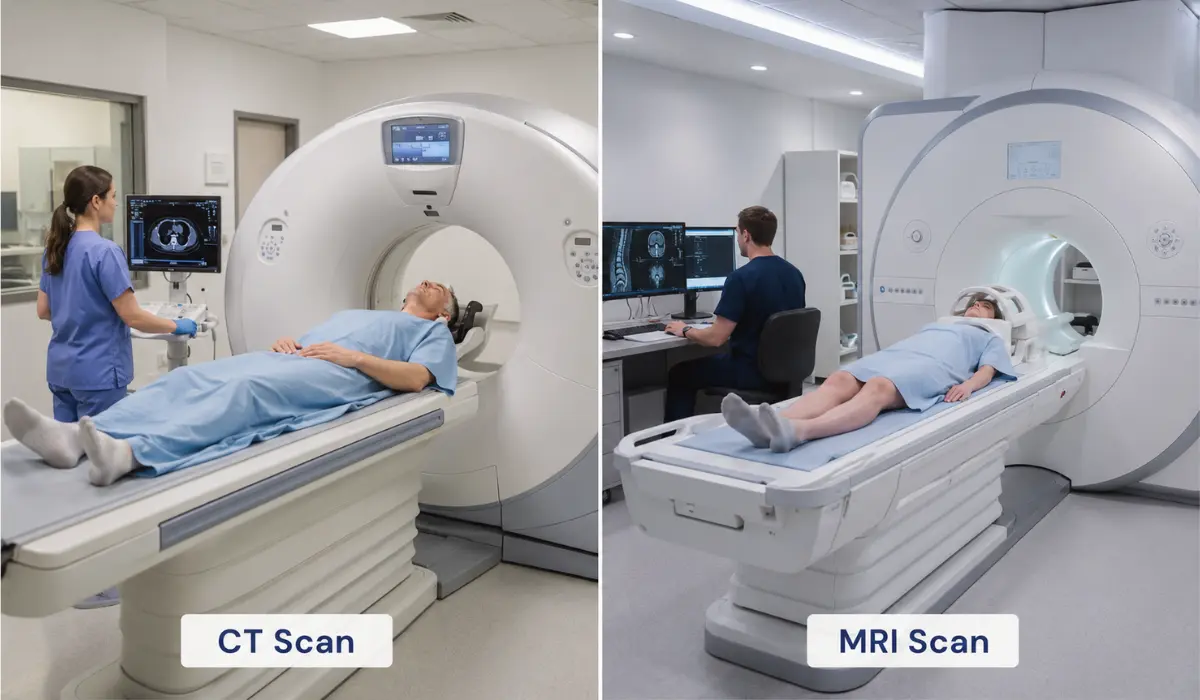
Medical scans help doctors see what is happening inside the body without surgery. Two of the most common imaging tests are MRI and CT scans. Many people hear these names at hospitals or diagnostic centers but are not always sure how they are different.
The difference between MRI and CT scan mainly comes down to the technology used, the type of body details each scan shows best, scan time, comfort level, and safety factors. Both tests are useful, but they are not used for the same reason in every case.
Why Doctors Choose Different Scans?
Doctors do not choose a scan randomly. They usually select MRI or CT based on the health problem, the body part being checked, how quickly results are needed, and whether the patient has any medical restrictions.
For example, one scan may be better for soft tissues like the brain, nerves, joints, and muscles, while another may be better for bones, bleeding, chest problems, or emergency injuries. The goal is to get the clearest image with the safest and most suitable method.
Image Detail And Body Areas Checked
MRI Gives Clear Soft Tissue Images
MRI is often preferred when doctors need detailed pictures of soft tissues. This includes the brain, spinal cord, ligaments, muscles, joints, organs, and nerves. It can help show swelling, tumors, injuries, inflammation, and other changes in soft tissue.
This is why MRI is commonly used for brain problems, spine pain, knee injuries, shoulder injuries, nerve issues, and certain organ checks. It usually gives more detailed soft tissue contrast compared to a CT scan.
CT Scan Is Strong For Bones And Urgent Problems
A CT scan is often used when doctors need fast images of bones, lungs, blood, or internal injuries. It is commonly used after accidents, falls, head injuries, chest pain, abdominal pain, or suspected bleeding.
CT scans are especially helpful in emergency situations because they are quick and can show fractures, internal bleeding, lung infections, kidney stones, and some cancers. They provide cross-sectional images that help doctors review the body from different angles.
Scan Time And Patient Comfort
MRI Usually Takes Longer
An MRI scan usually takes longer than a CT scan. Depending on the body part, it may take 20 minutes to more than an hour. During the scan, the patient needs to lie still inside a tube-shaped machine.
Some people feel uncomfortable because the MRI machine can be noisy and narrow. People with claustrophobia may need extra support, relaxation techniques, or in some cases, mild medicine recommended by a doctor.
CT Scan Is Usually Faster
A CT scan is usually much quicker. Many CT scans can be completed within a few minutes, although preparation may take longer if contrast dye is needed. This speed is one reason CT is often used in emergency care.
The CT machine is also more open compared to an MRI machine. Patients usually pass through a ring-shaped scanner, which may feel less closed-in. This can make CT easier for people who feel anxious in tight spaces.
Radiation And Safety Differences
MRI Does Not Use Radiation
One important difference between MRI and CT scan is radiation. MRI does not use X-ray radiation. Instead, it uses a strong magnetic field and radio waves to create detailed images.
Because MRI uses magnets, it may not be suitable for people with certain implants, pacemakers, metal fragments, or some medical devices. Patients must tell the medical team about any metal inside the body before the scan.
CT Scan Uses X-Ray Radiation
A CT scan uses X-rays to create images. The radiation dose is usually controlled and kept as low as possible, but it is still an important factor, especially for children, pregnant women, or people who need repeated scans.
Doctors usually recommend CT when the benefits are greater than the radiation risk. In urgent cases, CT can provide fast and useful information that may help guide immediate treatment.
Contrast Dye And Preparation
MRI Contrast May Be Used For Better Detail
Some MRI scans use a contrast dye to make certain tissues, blood vessels, or abnormal areas clearer. This is usually given through a vein. Not every MRI needs contrast, so the decision depends on the condition being checked.
Patients with kidney problems, allergies, or past reactions to contrast should tell their doctor before the scan. The medical team may ask questions or perform blood tests before using contrast.
CT Contrast Can Highlight Organs And Blood Vessels
CT scans may also use contrast dye. It can be given through a vein or sometimes taken as a drink, depending on the body area being checked. Contrast can help show organs, blood vessels, infections, tumors, or digestive tract issues more clearly.
Some people may feel warmth or a metallic taste after CT contrast. These feelings usually pass quickly. As with MRI contrast, patients should inform the medical team about kidney disease, allergies, pregnancy, or past contrast reactions.
Cost And Availability
MRI May Cost More
MRI scans are often more expensive than CT scans. This is because MRI machines are more complex, the scan takes longer, and the imaging process requires more time and resources.
In some areas, MRI appointments may also take longer to schedule. However, when detailed soft tissue imaging is needed, the extra cost and time may be worth it for accurate diagnosis.
CT Scan Is Often More Available
CT scans are widely available in hospitals and diagnostic centers. They are commonly used in emergency departments because they are fast and practical for many urgent conditions.
In many cases, CT may be more affordable than MRI. Still, cost depends on the location, body part scanned, use of contrast, insurance coverage, and the healthcare facility.
When MRI May Be Preferred?
MRI may be preferred when the doctor wants a closer look at soft tissues, nerves, joints, or the brain. It is often used for spine problems, ligament tears, brain conditions, muscle injuries, and certain abdominal or pelvic concerns.
It may also be chosen when avoiding radiation is important. However, MRI is not always the best choice for people with certain metal implants or those who cannot stay still for a longer time.
When CT Scan May Be Preferred?
A CT scan may be preferred when speed matters. It is commonly used for trauma, suspected internal bleeding, bone fractures, lung problems, kidney stones, and emergency head or chest evaluations.
It may also be used when MRI is not safe or not practical for a patient. CT gives doctors fast information, which can be very important during urgent treatment decisions.
Choosing The Right Scan
Patients usually do not need to decide between MRI and CT on their own. The doctor will recommend the scan based on symptoms, medical history, urgency, and the body part involved.
Still, it is helpful to ask why a certain scan is being recommended. Patients can also ask about radiation, contrast dye, preparation, cost, and whether they need to avoid eating or drinking before the test.
Final Thoughts
The main difference between MRI and CT scan is that MRI uses magnets and radio waves, while CT uses X-rays. MRI is usually better for detailed soft tissue images, while CT is faster and often better for bones, bleeding, lungs, and emergency cases.
Both scans are valuable tools in modern healthcare. The best scan depends on the person’s condition, safety needs, and the type of information the doctor needs to make the right diagnosis.
Frequently Asked Questions
MRI is not always better than CT. MRI is better for soft tissues, nerves, and joints, while CT is better for fast emergency imaging, bones, lungs, and bleeding.
MRI does not use radiation, so it may be safer in that way. However, MRI may not be safe for people with certain metal implants or devices.
A doctor may order a CT scan when quick results are needed, especially for injuries, bleeding, fractures, lung issues, kidney stones, or emergency conditions.
Sometimes they can show similar problems, but not always with the same detail. Each scan has strengths, so doctors choose based on the body part and condition.
MRI can show nerve compression or tumors, while CT may show bone-related pressure. Doctors may need specialized imaging or nerve tests for a complete diagnosis.