
Many people become confused when they hear the terms “CAT scan” and “CT scan.” Patients often wonder whether these are two different imaging tests or if one is more advanced than the other. The simple answer is that a CAT scan and a CT scan are the same medical imaging procedure.
The difference lies primarily in the name. Over time, medical professionals gradually shifted from using the term CAT scan to CT scan, but both refer to the same diagnostic imaging technology.
Understanding what these scans are, how they work, and when they are used can help patients feel more informed before undergoing an examination.
What Is A CT Scan?
CT stands for Computed Tomography. A CT scan is a diagnostic imaging procedure that uses X-rays and advanced computer technology to create detailed cross-sectional images of the body.
Unlike a traditional X-ray, which produces a single image, a CT scan takes multiple images from different angles. A computer then combines these images to create detailed pictures of organs, bones, blood vessels, and soft tissues.
Because of its ability to provide highly detailed images, CT scanning is one of the most commonly used diagnostic tools in modern medicine.
What Is A CAT Scan?
CAT stands for Computed Axial Tomography.
When the technology was first introduced, the term “axial” referred to the way images were captured in slices across the body. As imaging technology advanced and became capable of creating images from multiple planes and three-dimensional reconstructions, the medical community gradually adopted the simpler term “Computed Tomography” or CT.
Today, both terms describe the exact same scan.
CAT Scan vs CT Scan: Key Difference
The most important thing patients should know is that there is no difference in the actual procedure.
| Feature | CAT Scan | CT Scan |
| Full Name | Computed Axial Tomography | Computed Tomography |
| Technology | Same | Same |
| Uses X-rays | Yes | Yes |
| Produces Cross-Sectional Images | Yes | Yes |
| Current Medical Term | Less Common | More Common |
In modern healthcare settings, “CT scan” is the preferred terminology, while “CAT scan” is still widely recognized by patients and the general public.
How Does A CT Scan Work?
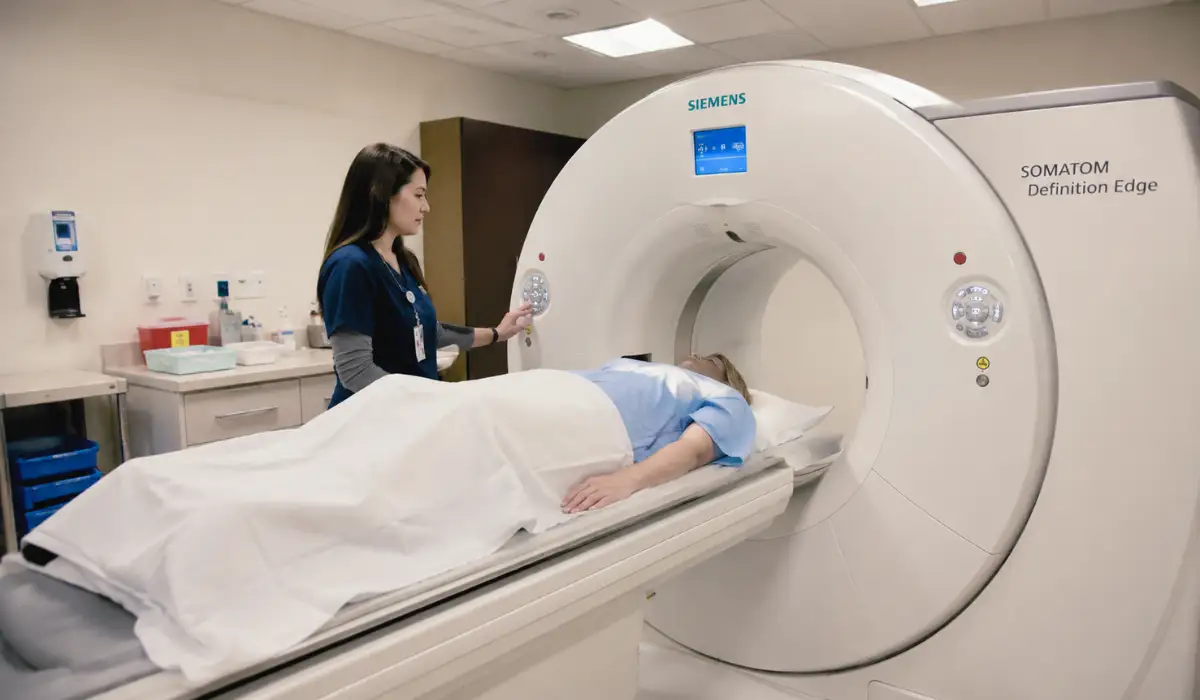
A CT scanner consists of a large, donut-shaped machine. During the procedure, the patient lies on a motorized table that slowly moves through the scanner.
Inside the machine, an X-ray tube rotates around the body while detectors capture images from multiple angles. A computer processes the data and creates highly detailed cross-sectional images.
These images allow physicians to examine internal structures without surgery.
Why Are CT Scans Performed?
CT scans help physicians diagnose, monitor, and evaluate a wide range of medical conditions.
Common reasons for a CT scan include:
- Detecting fractures and bone injuries
- Evaluating head injuries
- Diagnosing strokes
- Identifying tumors and cancers
- Detecting infections
- Examining internal bleeding
- Evaluating chest and lung conditions
- Investigating abdominal pain
- Monitoring treatment progress
Because CT scans provide detailed images quickly, they are often used in emergency situations.
Types Of CT Scans
Different CT scans are designed to evaluate specific areas of the body.
Head CT Scan
Used to examine the brain, skull, and surrounding structures. It can help diagnose strokes, bleeding, tumors, and traumatic injuries.
Chest CT Scan
Provides detailed images of the lungs, heart, and blood vessels. Physicians often use chest CT scans to evaluate lung disease, infections, or chest pain.
Abdominal CT Scan
Examines organs such as the liver, kidneys, pancreas, spleen, and intestines.
Cardiac CT Scan
Focuses on the heart and coronary arteries to assess cardiovascular health.
CT Angiography
Uses contrast material to evaluate blood vessels and blood flow throughout the body.
What Is Contrast Dye?
Some CT scans require the use of contrast material, often called contrast dye.
Contrast helps certain organs, tissues, and blood vessels appear more clearly on imaging results. Depending on the examination, contrast may be:
- Injected into a vein
- Swallowed as a liquid
- Administered through other methods
Not every CT scan requires contrast. Your healthcare provider will determine whether it is necessary.
Benefits Of CT Scans
CT scanning offers several advantages that make it one of the most valuable imaging tools available.
Fast Results
Most CT scans are completed within minutes, making them ideal for emergency situations.
Detailed Images
CT scans provide far more detail than standard X-rays.
Non-Invasive Procedure
No surgery is required to obtain internal images.
Accurate Diagnosis
The detailed images help physicians identify conditions quickly and accurately.
Supports Treatment Planning
CT imaging helps doctors develop appropriate treatment strategies and monitor progress.
Are CT Scans Safe?
CT scans are generally considered safe and are performed millions of times each year.
Because CT scans use X-rays, patients are exposed to a small amount of radiation. However, healthcare providers carefully weigh the benefits of imaging against potential risks. In most cases, the diagnostic value significantly outweighs the minimal radiation exposure.
Patients who are pregnant or believe they may be pregnant should inform their healthcare provider before undergoing a CT scan.
What Should Patients Expect During A CT Scan?
Most CT examinations are straightforward and painless.
Typically, patients will:
- Change into a medical gown if necessary.
- Lie on the scanning table.
- Remain still while images are captured.
- Follow breathing instructions when requested.
- Complete the scan within 10-30 minutes.
After the examination, most patients can immediately return to normal activities unless additional instructions are provided.
Conclusion
When comparing CAT scans and CT scans, there is actually no difference between the two. CAT scan is simply the older term for what healthcare professionals now commonly call a CT scan.
Both names refer to the same advanced imaging technology that uses X-rays and computer processing to create detailed images of the body’s internal structures.
Whether evaluating injuries, diagnosing disease, or monitoring treatment progress, CT scanning remains one of the most important diagnostic tools in modern medicine.
Understanding that CAT scan and CT scan are the same procedure can help patients feel more confident and informed when discussing imaging tests with their healthcare providers.
FAQs
Yes. A CAT scan and CT scan are the same imaging test. CT scan is the newer and more commonly used medical term.
CT stands for Computed Tomography. It uses X-rays and computer technology to create detailed cross-sectional images of the body.
CAT scan is the older term, meaning Computed Axial Tomography. Many people still use it, but most healthcare providers now say CT scan.
No. A CT scan is generally painless. Patients only need to lie still while the machine takes images.
No. Some CT scans use contrast dye to make organs or blood vessels clearer, but not every scan requires it.
Most CT scans take about 10 to 30 minutes, depending on the body area being scanned and whether contrast is used.