The teres minor function is to help rotate the upper arm outward and stabilize the shoulder joint. This small rotator cuff muscle works with the infraspinatus, deltoid, and other shoulder muscles to support smooth arm movement.
The teres minor muscle is especially important during throwing, reaching, lifting, swimming, and overhead activity. When it becomes strained, weak, irritated, or affected by the axillary nerve, it may contribute to posterior shoulder pain, external rotation weakness, or rotator cuff symptoms.
Teres Minor Muscle Function: Important Points
The teres minor is one of the four rotator cuff muscles, along with the supraspinatus, infraspinatus, and subscapularis. Together, these muscles help stabilize the shoulder and guide arm movement.
Teres minor function is most noticeable during external shoulder rotation. This movement happens when the elbow stays near the body while the forearm turns away from the abdomen.
The teres minor also assists shoulder joint stability. It helps prevent the upper arm bone from shifting too much while larger muscles, such as the deltoid, move the arm.
Weakness in the teres minor muscle may make throwing, serving, swimming, or reaching behind the body harder. Some people also notice shoulder fatigue during repeated overhead activity.
Teres minor injury symptoms may overlap with infraspinatus pain, rotator cuff tendinopathy, shoulder impingement, or quadrilateral space syndrome. A proper shoulder exam helps identify the true cause.
Teres Minor Anatomy Overview
| Feature | Details |
| Muscle name | Teres minor muscle |
| Muscle group | Rotator cuff |
| Main function | External rotation of the shoulder |
| Secondary role | Shoulder stabilization |
| Location | Back of the shoulder, near the lateral border of the scapula |
| Origin | Lateral border of the shoulder blade |
| Insertion | Greater tubercle of the humerus |
| Nerve supply | Axillary nerve |
| Common related symptoms | Posterior shoulder pain, weakness, reduced rotation |
| Related conditions | Rotator cuff tear, shoulder impingement, axillary nerve injury, quadrilateral space syndrome |
The teres minor is small, but its role in rotator cuff function is important. It works closely with the infraspinatus to rotate the arm outward and protect shoulder mechanics.
Teres Minor Muscle Anatomy and Shoulder Movement
The teres minor muscle sits on the back of the shoulder blade. It runs from the outer border of the scapula to the upper arm bone, where it attaches near the shoulder joint.
Because of this position, the teres minor can pull the humerus into external rotation. This movement is needed for throwing, reaching to the side, putting on a jacket, and controlling the arm during overhead motion.
The muscle also supports the glenohumeral joint, which is the main shoulder joint. Since this joint is highly mobile, the rotator cuff must work constantly to keep movement controlled and stable.
Why Teres Minor Function Matters?
Teres minor function matters because the shoulder depends on both mobility and stability. The shoulder can move in many directions, but that freedom also makes it vulnerable to strain, weakness, and rotator cuff injury.
During arm elevation, the deltoid lifts the arm while the rotator cuff keeps the humeral head centered. The teres minor helps balance this force, especially during external rotation and overhead shoulder movement.
This is why athletes, lifters, swimmers, tennis players, and baseball pitchers often need strong rotator cuff control. Even mild teres minor weakness can affect shoulder endurance and movement quality.
Teres Minor Pain and Common Symptoms
Teres minor pain is usually felt at the back or outer part of the shoulder. Some people describe it as a deep ache, tightness, soreness, or sharp discomfort during external rotation.
Common teres minor symptoms may include shoulder weakness, pain when reaching overhead, difficulty throwing, reduced arm rotation, or discomfort when sleeping on the affected side. Pain may also spread toward the upper arm.
Teres minor trigger points can sometimes create referred pain around the shoulder or upper arm. However, similar symptoms can also come from the infraspinatus, neck nerves, bursitis, labral injury, or a larger rotator cuff problem.
Common Causes of Teres Minor Problems
Teres minor muscle problems may develop from repetitive overhead activity, sudden shoulder injury, poor throwing mechanics, heavy lifting, or rotator cuff overuse. These causes can irritate the muscle, tendon, or nearby shoulder structures.
A teres minor strain may occur when the muscle is overstretched or loaded suddenly. This can happen during throwing, pulling, falling, weight training, or forceful external rotation.
Axillary nerve irritation can also affect teres minor function. Since the axillary nerve supplies the teres minor and deltoid, nerve injury may cause weakness, numbness near the shoulder, or visible muscle wasting.
Quadrilateral space syndrome is another possible cause of teres minor weakness or atrophy. This condition involves compression near the back of the shoulder where the axillary nerve and blood vessels pass.
Teres Minor vs Infraspinatus Function
The teres minor and infraspinatus both help with shoulder external rotation. The infraspinatus is usually the stronger external rotator, while the teres minor adds support and helps stabilize the shoulder.
These two posterior rotator cuff muscles often work together during throwing, reaching, and overhead movement. Pain in one area may feel similar because both muscles sit near the back of the shoulder.
The teres minor is supplied by the axillary nerve, while the infraspinatus is supplied by the suprascapular nerve. This difference matters when doctors evaluate nerve-related shoulder weakness or muscle atrophy.
How Teres Minor Problems Are Diagnosed?
A healthcare provider may evaluate teres minor function by checking shoulder range of motion, external rotation strength, tenderness, posture, and shoulder blade control. The exam often compares both shoulders.
Doctors may use resisted external rotation testing to see whether pain or weakness appears. They may also examine the neck, deltoid strength, sensation over the outer shoulder, and signs of axillary nerve involvement.
Imaging may be recommended when symptoms persist or a rotator cuff tear is suspected. X-rays can rule out bone problems, while ultrasound or shoulder MRI can assess soft tissues such as rotator cuff tendons and muscle quality.
Teres Minor Treatment and Management
Teres minor treatment depends on the cause. Mild muscle strain or overuse pain may improve with activity modification, rest from painful movements, ice after acute irritation, and gradual rehabilitation.
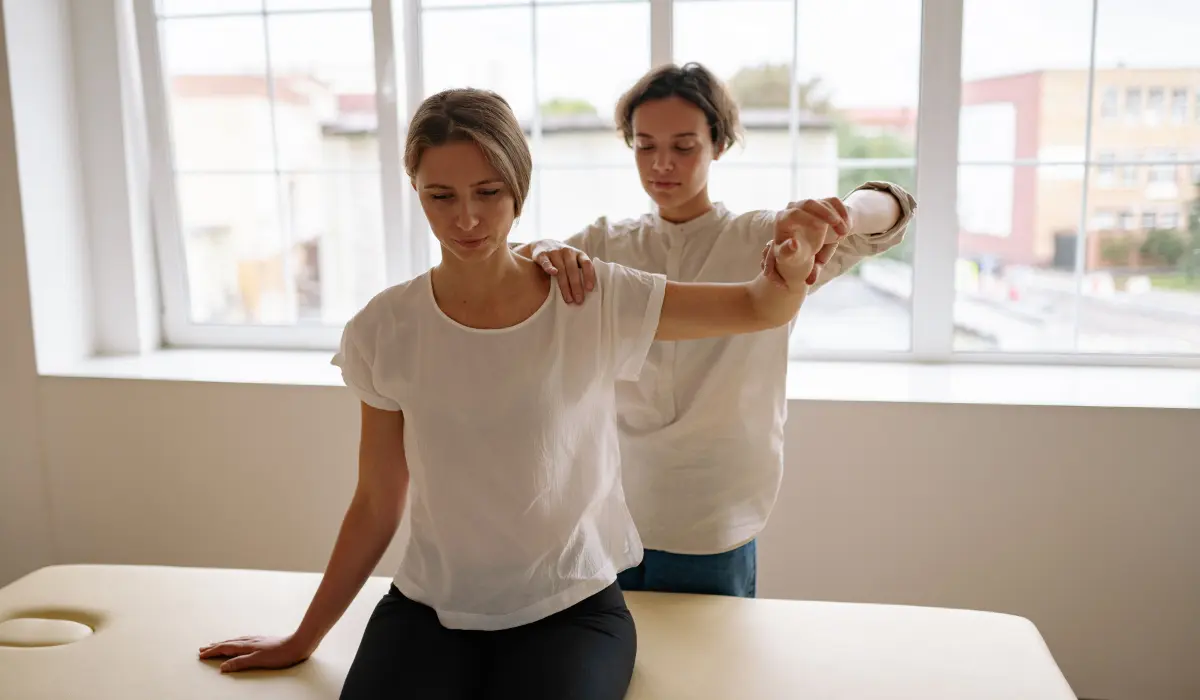
Physical therapy often focuses on restoring shoulder mobility, rotator cuff strength, scapular control, and external rotation endurance. A safe plan should match the diagnosis, pain level, and activity goals.
If pain is caused by a larger rotator cuff tear, nerve compression, shoulder instability, or a traumatic injury, treatment may be different. Some cases need specialist evaluation, imaging, injections, or surgery.
Teres Minor Exercises for Shoulder Stability
Teres minor exercises usually target external rotation and rotator cuff control. They should be performed slowly and without sharp pain.
Common options include side-lying external rotation, resistance-band external rotation, isometric external rotation, and controlled shoulder blade retraction. These exercises may also support infraspinatus strength and shoulder stability.
Do not force heavy resistance too early. Increasing load too quickly can worsen rotator cuff tendinopathy, shoulder impingement, or posterior shoulder pain.
Teres Minor vs Infraspinatus Function
The infraspinatus muscle and teres minor work together because both help with shoulder external rotation. The infraspinatus is usually the stronger external rotator, while teres minor function adds extra support for shoulder stability during throwing, lifting, swimming, and overhead movement.
Although these muscles perform similar actions, they have different nerve supplies. The infraspinatus muscle is controlled by the suprascapular nerve, while the teres minor is controlled by the axillary nerve. This difference helps doctors evaluate rotator cuff weakness, nerve injury, and posterior shoulder pain more accurately.
Practical Steps to Support Teres Minor Function
Start by reducing activities that repeatedly trigger teres minor pain, such as heavy overhead lifting, hard throwing, or aggressive pulling. Temporary modification can help calm irritated rotator cuff tissue.
Use gentle mobility work and light external rotation exercises only if they do not increase symptoms. A physical therapist can help correct technique and decide when to progress resistance.
Warm up before sports or lifting. Shoulder circles, light band work, scapular activation, and gradual throwing or swimming intensity may help prepare the rotator cuff for activity.
Teres Minor Function Myths and Facts
One myth is that the teres minor is not important because it is small. In reality, this muscle contributes to shoulder external rotation and helps stabilize the upper arm during movement.
Another misunderstanding is that all posterior shoulder pain comes from teres minor trigger points. Pain in this area may also involve the infraspinatus, rotator cuff tendon, shoulder joint, neck, or axillary nerve.
Some people believe stretching alone fixes teres minor weakness. Stretching may help tightness, but weakness usually needs progressive strengthening and better shoulder mechanics.
It is also incorrect to assume that every rotator cuff tear requires surgery. Treatment depends on tear size, symptoms, weakness, age, activity level, and response to conservative care.
Risks and Complications of Teres Minor Dysfunction
Untreated teres minor dysfunction may contribute to ongoing shoulder weakness, poor external rotation control, fatigue, or altered overhead mechanics. This can affect sports, lifting, work tasks, and daily movement.
If the problem is actually a rotator cuff tear, symptoms may worsen with continued overload. Pain at night, weakness, clicking, or difficulty lifting the arm should not be ignored.
Nerve-related teres minor atrophy may cause visible muscle wasting and persistent weakness. Axillary nerve injury, quadrilateral space syndrome, or shoulder dislocation history should be assessed by a medical professional.
When to Seek Professional Help?
Seek medical care if teres minor pain lasts more than a few weeks, limits daily activity, causes night pain, or creates noticeable external rotation weakness. Persistent rotator cuff symptoms need proper evaluation.
Get urgent care after a fall, shoulder dislocation, sudden severe pain, major weakness, numbness, deformity, or inability to lift the arm. These symptoms may indicate a tear, fracture, nerve injury, or other serious shoulder problem.
Also seek help if shoulder pain travels with neck pain, tingling, or hand weakness. These symptoms may suggest cervical nerve involvement rather than an isolated teres minor muscle issue.
Questions to Ask a Healthcare Provider
- Is my pain coming from the teres minor, infraspinatus, rotator cuff tendon, shoulder joint, or neck?
- Do I have teres minor strain, tendinopathy, trigger points, or a rotator cuff tear?
- Is the axillary nerve involved in my shoulder weakness?
- Do I need an ultrasound, X-ray, or shoulder MRI?
- Which teres minor exercises are safe for my current condition?
- Should I avoid throwing, swimming, lifting, or overhead work temporarily?
- How long should recovery take for my type of shoulder injury?
- Would physical therapy help restore external rotation strength?
- Are there signs of quadrilateral space syndrome or nerve compression?
- When should I return to sports or heavy training?
Conclusion
Teres minor function is essential for shoulder external rotation, rotator cuff stability, and controlled arm movement. Although the muscle is small, it plays an important role in throwing, reaching, lifting, and overhead activity.
Pain or weakness around the teres minor can come from muscle strain, rotator cuff injury, shoulder impingement, nerve irritation, or quadrilateral space syndrome. Proper diagnosis and progressive rehabilitation can help protect shoulder function and reduce long-term problems.
FAQS
The main teres minor function is external rotation of the shoulder. It also helps stabilize the humeral head in the shoulder socket during arm movement.
The teres minor muscle is located at the back of the shoulder. It runs from the lateral border of the scapula to the upper humerus.
Teres minor pain may feel like a deep ache or soreness behind the shoulder. It can worsen with throwing, lifting, reaching overhead, or external rotation.
The axillary nerve controls the teres minor muscle. Injury or compression of this nerve may cause external rotation weakness or muscle atrophy.
Yes. The teres minor is one of the four rotator cuff muscles, along with the supraspinatus, infraspinatus, and subscapularis.
Side-lying external rotation, resistance-band external rotation, and isometric external rotation can strengthen the teres minor when performed safely and progressively.
Yes. Teres minor weakness may affect shoulder mechanics and contribute to pain, fatigue, or poor control during overhead movement or sports.
Diagnosis usually involves a shoulder exam, strength testing, range-of-motion checks, and sometimes imaging such as ultrasound or MRI if a rotator cuff tear is suspected.
Many mild teres minor strains and overuse problems improve with rest, activity modification, and physical therapy. Surgery is usually reserved for more serious structural problems.
See a healthcare provider if pain persists, causes weakness, follows trauma, disturbs sleep, or limits shoulder movement. Sudden severe weakness needs prompt evaluation.